
Panic attacks can be frightening, overwhelming, and often seem to come “out of the blue”. Many people describe feeling convinced they are having a heart attack, losing control, going to collapse, or even die. The intensity of these experiences can leave people fearing the next attack, changing their routines, or avoiding situations where panic might occur again.
Although panic attacks can feel dangerous, they are not. They are the body’s natural threat response becoming activated at the wrong time or in response to a perceived rather than actual threat. Understanding why panic attacks happen is often the first step towards breaking the cycle.
What Is a Panic Attack?
A panic attack is a sudden surge of intense fear or discomfort accompanied by a range of physical sensations and distressing thoughts. Symptoms typically build rapidly, often reaching their peak within around ten minutes, although they can feel much longer to the person experiencing them.
Many people experience a panic attack at some point in their lives. Having a panic attack does not necessarily mean someone has Panic Disorder. Panic Disorder is characterised by recurrent, unexpected panic attacks together with persistent worry about having further attacks and changes in behaviour aimed at preventing them.
Clinical frameworks used within UK healthcare describe panic attacks as involving a combination of physical symptoms and catastrophic interpretations of those symptoms. Importantly, while the sensations experienced during a panic attack are very real, they are not usually a sign that something dangerous is happening to the body.
Common Signs and Symptoms of Panic Attacks
While everyone’s experience is unique, panic attacks often involve a combination of physical sensations, thoughts, and behavioural responses.
- Physical Symptoms
People commonly describe:
- A racing or pounding heart
- Chest tightness or discomfort
- Shortness of breath or feeling unable to get enough air
- Dizziness or light-headedness
- Trembling or shaking
- Sweating
- Tingling or numbness
- Nausea or an unsettled stomach
- Feeling hot or cold
- Feeling detached from yourself or your surroundings
These sensations are part of the body’s fight-or-flight response and, although extremely uncomfortable, are not harmful.
- Thoughts During a Panic Attack (Catastrophic Thinking)
People often report thoughts such as:
- “I’m having a heart attack.”
- “I’m going to faint.”
- “I’m going to lose control.”
- “I’m going crazy.”
- “I’m going to stop breathing.”
- “Something terrible is about to happen.”
These thoughts can increase fear because they signal to the brain that something is wrong or unsafe, further activating the threat response. This can make the physical sensations feel even more intense, reinforcing the belief that something is wrong and keeping the panic cycle going.
- Behavioural Responses
After experiencing panic, many people begin trying to prevent another attack. This can include:
- Leaving situations early
- Seeking reassurance from others
- Carrying medication, water, or other “just in case” items
- Sitting close to exits
- Avoiding exercise because it increases heart rate
- Avoiding places associated with previous panic attacks
- Constantly monitoring bodily sensations for signs that panic is returning
These strategies can provide short-term relief, but they may unintentionally reinforce the belief that panic is dangerous. When nothing bad happens, it can be attributed to the safety behaviour — “I was okay because I sat near the exit” — rather than recognising that the feared outcome was unlikely to happen in the first place. This prevents the prediction from being properly tested, so the underlying belief remains unchanged and the safety behaviour continues to feel necessary.
Some people also experience dissociation during or around panic, including depersonalisation (feeling detached from yourself or your body) or derealisation (feeling as though your surroundings are unreal or unfamiliar). These experiences can be particularly frightening and may contribute to feeling unsafe or unable to trust your own body. Although unsettling, they can occur as part of an anxiety or panic response.
Why Do Panic Attacks Happen?
The body’s threat response exists to protect us from danger. When a threat is detected, the nervous system releases adrenaline and prepares the body for action. Heart rate increases, breathing changes, muscles tense, and attention becomes focused on survival.
During a panic attack, this same system becomes activated even though there is no immediate physical danger. Periods of prolonged stress or heightened anxiety can leave the nervous system more reactive and reduce our capacity to tolerate further stress or arousal. We all have limits to how much stress we can comfortably manage, and when these are repeatedly exceeded, relatively small changes or sensations can begin to feel overwhelming.
People who experience panic can also become highly focused on internal bodily sensations, such as changes in heart rate, breathing or dizziness. When these sensations feel uncomfortable or uncertain, they may be rapidly interpreted as a sign that something is wrong — “Why is my heart beating like that?” or “What if I faint?” That interpretation increases the perception of danger and further activates the threat response.
The brain can also learn associations from previous experiences of panic. A particular place, situation or bodily sensation may become associated with an earlier panic attack. Encountering something similar again can then trigger the threat response automatically, sometimes before the person is consciously aware of what has prompted it.
When sensations are interpreted as dangerous, fear increases. This produces further activation of the threat response and stronger physical sensations, which can appear to confirm that something is wrong. As fear rises, the cycle can build rapidly into a panic attack.
Understanding the Panic Cycle
The cognitive model of panic describes how bodily sensations can be catastrophically interpreted, increasing fear and physiological arousal and creating a self-reinforcing cycle (Clark & Salkovskis, 2009). Once the threat response is activated, panic can escalate very quickly.
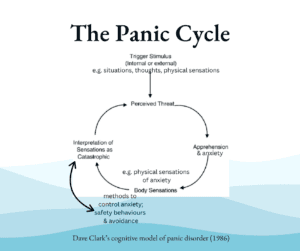
The panic cycle, based on the cognitive model of panic (Clark & Salkovskis, 2009).
This cycle can happen very rapidly and may feel automatic. Understanding each stage makes it possible to identify where the cycle can be interrupted and where beliefs about the sensations can begin to be tested and updated.
Why Panic Attacks Keep Coming Back
After experiencing a panic attack, it is understandable to become concerned about it happening again. This can lead to patterns that unintentionally maintain the fear of panic, including:
- Heightened awareness of bodily sensations — noticing small changes in heart rate, breathing, balance or other physical sensations that might previously have gone unnoticed.
- Rapid catastrophic interpretations — interpreting these sensations as signs of danger, such as “I’m going to faint” or “something is wrong with my heart.”
- Anticipatory anxiety — worrying about when or where another panic attack might happen.
- Safety behaviours — relying on particular behaviours, people or objects to feel safe, which can prevent feared predictions from being tested.
- Avoidance — beginning to avoid places, activities or situations associated with panic, reducing opportunities to learn that they can be experienced safely.
- Fear of panic itself — becoming frightened not only of a particular situation or sensation, but of experiencing the panic response again.
Together, these patterns can reinforce the belief that panic is dangerous and needs to be prevented, allowing the cycle to continue.
How Therapy Can Help
When panic attacks become recurrent or begin limiting everyday life, therapy can help people understand what is happening rather than feeling controlled by it.
From a pluralistic perspective, there is no single approach that suits everyone, but working with panic will often involve developing a clear understanding of the panic cycle and what is happening in the body during the threat response. Psychoeducation can help challenge rapid, automatic interpretations of bodily sensations as dangerous, while gradually increasing the capacity to experience uncomfortable sensations without immediately responding to them as a threat. Reducing safety behaviours and using behavioural experiments can then help test feared predictions and build new evidence that challenges existing beliefs about panic.
In practice, this might look something like:
Understand the physiology → recognise automatic interpretations → experience sensations differently → reduce safety behaviours → test predictions → update beliefs
Where appropriate, therapy may also explore the wider context in which panic developed. Periods of chronic stress, trauma, significant life events, or earlier experiences can all contribute to increased sensitivity within the threat system. A collaborative approach allows this work to be tailored to the individual’s needs and goals.
When to Consider Seeking Support
If panic attacks are becoming more frequent, leading you to avoid places or situations, or affecting work, relationships, or your quality of life, it may be helpful to seek support. You do not need to wait until panic has taken over your life before asking for help.
Many people choose counselling to understand panic more deeply, reduce the fear of panic, and develop new ways of responding. I offer online counselling across the UK and in-person sessions in Brighton and Hove. If you’re unsure whether therapy is right for you, you’re welcome to get in touch for an initial conversation.
Alternatively, your GP can be a good starting point for discussing your symptoms and exploring NHS treatment options.
If panic is accompanied by thoughts of harming yourself or you feel unable to keep yourself safe, seek urgent support through your GP, NHS 111, or your local crisis service.
Sources
- Sanders, D., & Wills, F. (2003). Counselling for Anxiety Problems (2nd ed.). SAGE Publications.
- Clark, D. M., & Salkovskis, P. M. (2009). Panic Disorder: Manual for Improving Access to Psychological Therapy (IAPT) High Intensity CBT Therapists. Panic Disorder IAPT Manual
- National Institute of Mental Health. Panic Disorder: What You Need to Know. National Institute of Mental Health – Panic Disorder